Green hydrogen is expected to become one of the pillars of future decarbonised energy systems. As international demand grows, new supply chains are emerging, connecting regions with abundant renewable resources to industrialised economies with high energy demand.
Although green hydrogen can contribute to reducing greenhouse gas emissions, decarbonisation alone does not guarantee a fairer energy transition. Under certain conditions, producing regions could primarily act as suppliers, while much of the economic value, technological development and decision-making power remain concentrated elsewhere. In this context, concepts such as energy justice and green extractivism are receiving increasing attention.
This study explores these aspects through a Life Cycle Sustainability Assessment (LCSA), integrating environmental, economic and social perspectives to evaluate international hydrogen supply chains based on Liquid Organic Hydrogen Carriers (LOHCs), a technology that enables hydrogen transport using existing liquid fuel infrastructure.
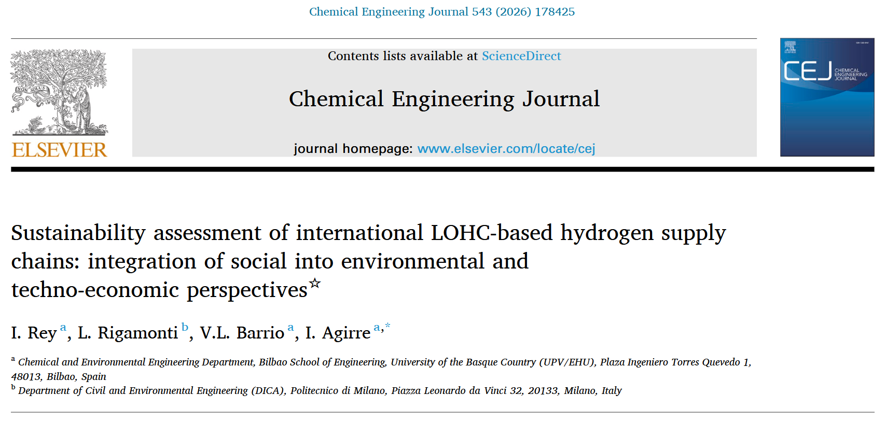
This article, published in Chemical Engineering Journal, forms part of the PhD research of Irene Rey, and was supervised by Lucia Rigamonti, and V. Laura Barrio and Ion Agirre, from the University of the Basque Country.
The results show that there is no universally sustainable hydrogen route. Instead, geographical configuration strongly influences sustainability performance and generates trade-offs between environmental impacts, economic competitiveness and social risks.
The full article is available at the following link.
Post prepared by Irene Rey